What actually breaks inside a Wheelwriter
Two typewriters off the same lot, the same service, and a failure mode most repair guides skip entirely.
Two IBM Wheelwriter typewriters came off the same lot, bought untested, and went through the same carrier rail and stepper service. Both now power on and type. That is a plainer result than it sounds, and it is worth explaining why a machine like this needs that specific service rather than just a wipe-down and a fresh ribbon.
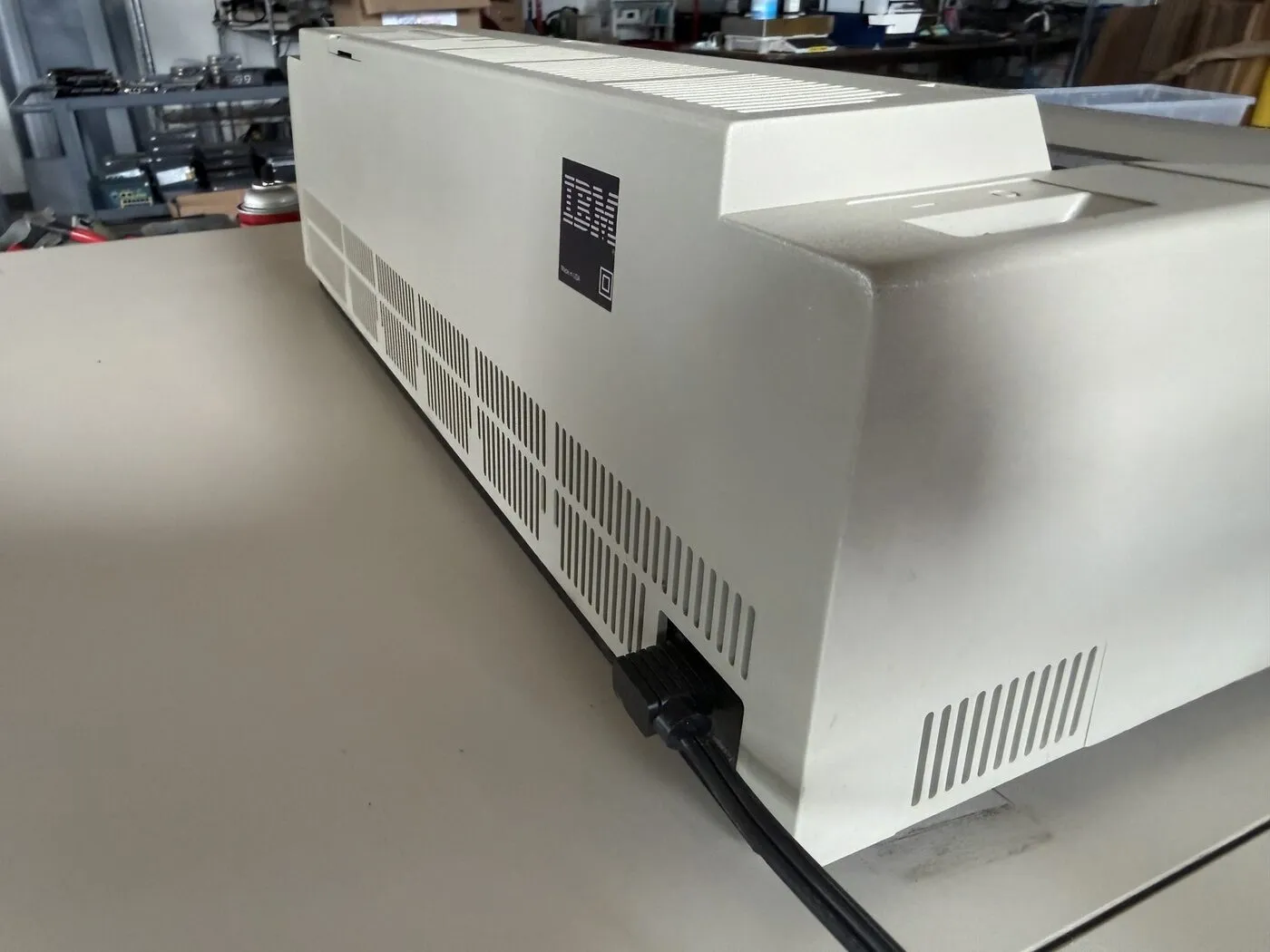
Both units came in as untested lot stock. The specification plate on the rear is what pins down the exact model before any service work starts.
The failure class this model is known for
Our own repair reference for this model documents a specific, easy-to-misdiagnose failure: a carrier that jams or hesitates on a cold start, a carriage return that does not travel all the way left, or margins that seem to reset themselves. All three read like electronics. A machine that behaves differently right after a power cycle looks like it has a control-board fault or a bad connection.
It usually is not. A Wheelwriter tracks the carrier’s position by counting stepper motor steps, not by a physical sensor reading a scale. If the carrier loses steps to friction anywhere along its travel, the machine’s own idea of where the carrier sits drifts away from where it actually is, and that drift is what produces all three symptoms above. Chasing the electronics or the margin settings first is how this repair goes long on a machine that just needs its rail cleaned.
What the reference procedure actually calls for
Our shop notes for this model put real weight on one step in particular: the stepper motor bearing, not just the carrier rail. Cleaning and re-oiling the rail is the obvious half of the job. The stepper bearing is the half that gets missed, because servicing it means unbolting the motor off its bracket rather than just working on the rail you can already see. The notes are blunt about it: a dry stepper bearing alone reproduces the same grinding, lost-position symptom even after a perfect rail service, so skipping it means the fix does not hold.
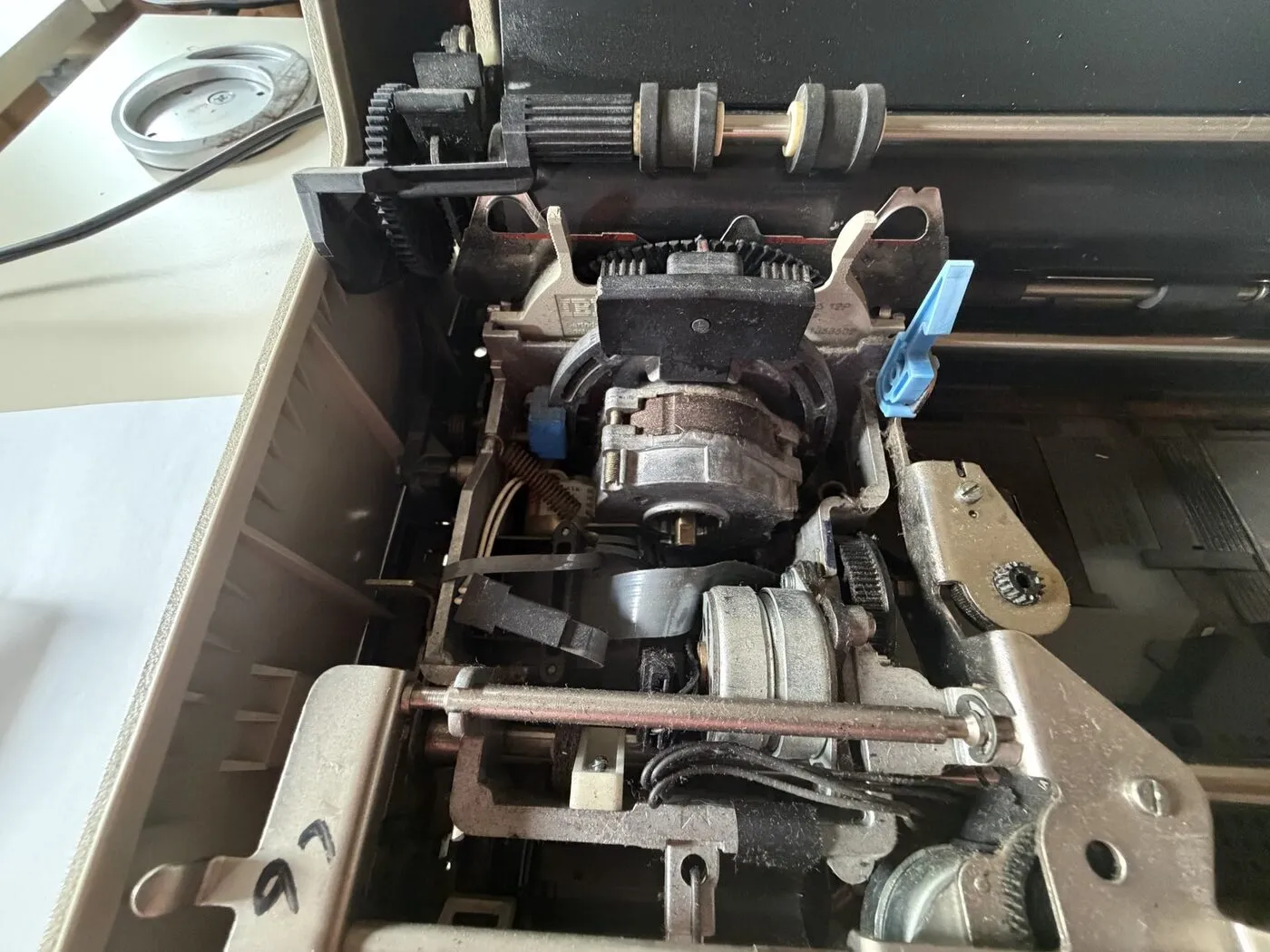
The carrier assembly with the cover off. The stepper motor bracket at the centre is the part that has to come off to service the bearing behind it.
What we actually did to these two
Both units went through the documented service: carrier rail and bushings cleaned and relubricated, and a fresh ribbon fitted. Neither unit needed anything more exotic than that to come back to life.
| Step | Result |
|---|---|
| Carrier rail and bushings | Cleaned and relubricated per our shop’s repair reference for this model |
| Ribbon | Replaced with fresh stock |
| Function check | Powers on and types |
| Proof | Working demo video shot 2026-08-05 |
Both machines type cleanly now, and the demo video from the bench is the proof, not just a claim in a listing description.
What tested and working is worth on a machine like this
A Wheelwriter that types is a genuinely different item from one that only powers on. Comps indicate a tested, typing unit is worth meaningfully more than a powers-on-only one, something in the neighborhood of $143 against roughly $40 for a unit that only powers on. Neither of these units has sold yet, so that gap is a comp, not a result, but it is the reason the bench time on a machine this old is worth spending.